Current Gaming Projects

Tuesday, January 4, 2011

Civilians in Wargaming – The Black Topic

On another blog that I periodic check up on, “Lebanon 1982”, the author Jon asked a question on one of his recent blog entries about how do others handled civilians in war gaming. See the following link for the blog entry: http://lebanon1982.blogspot.com/2010/12/civilians-in-modern-wargames.html I started to reply to his blog, but then realized that my reply was rather lengthy. So instead of replying to Jon’s blog entry only, I decided that I would write it for my blog on this subject, as I do use civilians in my games. So let us start this black topic!

Comfort level

Unfortunately, the sad fact is that civilians are very much part of war and suffer usually the worse. Because of this, most gamers have refuse to include this element in their gaming as they prefer to sanitize their views of war on the tabletop, even so much as not to even have miniatures of wounded or dead soldiers in their games. I am not berating these gamers, as I fully understand the reason why they want to sanitize their games to be strictly a game about combatants. I will say that the essay is probably not for them, but I am still encouraging them to read this entry to at least see possible options that can be open to them with the inclusion of civilians in wargaming.

The issue of whether or not to use civilian figures or stands in a game comes down to the comfort level of the game master and the players in the end. If a game master plans to have civilians on the table that can or will be used as possible victims, they should clearly spell that out at the beginning of the game so any players that will have issues with it can leave and seek a different game. If a game master has issues with the possibility of civilians getting harmed in a game, then they should not design a game where civilians are present. My own personal comfort level is that I am willing to have civilians on board that could possibly have harm done towards them as it reflects the more realistic challenges faced by combatants.

Why should civilians be in games?

Along time ago, I remember reading what I thought to be a best description of asymmetrical warfare as to carry out a guerrilla campaign in the mountains, forests, and swamps might get stories and songs written about you, but to fight in the cities and towns will win you the war. While small maneuver groups of irregulars would still need to operate in a mobile war against regulars in the mountains, forests, or swamps, but with every advancement of technology made available to the regular forces, it will become harder and harder for the irregulars to fight that style of war. They will then be forced to fight almost entirely in population centers. The controlling the population centers is a needed requirement for irregulars to gather supplies and recruits. As such, most asymmetrical engagements should take place in or relatively near civilization. So if one was to doing any wargaming based off of asymmetrical style of warfare, then it is almost a requirement to have civilians represented in the games.

Rules for civilians in games

Several gaming companies have addressed the issue of civilians in war gaming in their rules, with two that I think have a good handle on this are Ambush Alley Games’ “Force on Force” and Too Fat Lardies’ “Charlie Don’t Surf.” I will not discuss the details for these rules but both look at the Rules of Engagement (ROE) by regular forces and repercussions for regulars engaging civilians. I highly suggest either one for game mechanics. In any game, regulars’ players should have clear cut ROE laid out to them on about civilians in the game and what the penalties are if civilians are engaged. Like wise, the irregulars should be told what penalties there are if they shoot up civilians, like maybe they will have a harder time recruiting or taxing for supplies, etc. or even possibly having some civilians take up arms against them!

Civilians as part of the game

Depending on the game, civilians can be a hindrance to movement or combat; used as part of the mission objective; supportive role to one or both sides; or possible hostile force. I will discuss each one of these in a little more detail and will try to provide at least one scenario idea for each one. It would be better to add to the game two or more of the following ideas to will a proper challenge to the players. For an example of this, in a Vietnam game that I ran a while back (see blog entry - http://sapperjoeswargamingtoys.blogspot.com/2009/04/recruits-convention-march-2009.html), the civilians were both a mission objective and a hindrance. They were a mission objective as the US forces had to round up the civilians and move them back to their village. Then they were also a hindrance to the US forces as the Divisional commander (me, the game master) would not allow the US players to use indirect fire or airstrikes until all civilian stands are under control by the US ground forces so not to accidentally bomb or shell civilians.

Hindrance: This would be the most realistic use of civilian figures in a game. Civilians will be dodging in and out of line of fire causing regulars to hold fire, forced to move to a different location for clear lanes of fire, use a detachment to keep people back out of the fight which also prevents them from being used in combat, or suffer the effects of shooting through the civilians. Also civilians can also be used to block movement routes with broken cars, masses milling in the streets, etc. This blocking of movement should affect both sides and should be non-deliberate or random in their directions of movement. An example of this is in one game, I had a vehicle check point (VCP) set up next to a farm that was manned by regulars. The irregulars had a sniper and a small protection cell to shoot up the VCP and leave the board. On the board were also civilians in cars driving up to the VCP and the farm’s staff going about and doing their jobs. This forced the regulars to act against everything, since they had to secure the area and did not know who was with the irregulars. After the irregulars attacked, the civilians in the cars rolled for individual morale to see how they would react to the firefight. It was very well possible to have someone run over a soldier or crash into the regular’s armored carrier, etc. 

Mission objective: This would be the second most realistic use of civilians in a game. Depending on the scale of the game, several options are open to explore. In large scale games, the most likely best option is that of relocating the civilians. This could be an abstract thing of combatants holding off an opposing force while their civilians move off board. Or another option is for combatants to take a direct approach of rounding up the civilians to a central area so they can be protected or moved out of the area, while other combatants are trying to prevent this. This example is reflected in the Vietnam game that I mention above where the US players had to up to and take control of the civilian stands and move them back to an assembly point. 

In a smaller scale of actions (skirmishes), the above options can still be done, but now additional options become more available like: snatching key individuals, VIP protection, hostage rescue, and making contact with key individuals. These themes are pretty straight forward for scenarios ideas, but one game could have a patrol of mercenaries hired to rescue a group of civilians from a foreign power in a prison. Both sides don’t want to kill the prisoners for various reasons (a political barraging chip or the money bonus for a successful mission).

Supportive force: By supportive, I am not referring that the civilians actively helpful to one side, but that their role is supportive in a passive means. When civilians take a more active role against one side, then I will refer it to be hostile which will be detailed in the next section. Supportive force can be neutral or for / against one side. The game master should first determine the mood of the civilians towards both sides and the overall willingness to be supportive in a combat zone. Some of this information could be shared with one or both sides so the players can try to think out side of the box about how to interact with civilians to defeat the opposing forces. You may not want to provide everything to the players so to encourage them to try to figure it out by themselves. Some supportive roles can be the following: medical assistance; providing information on enemy forces or equipment (including bombs or mines); providing information or identifying key persons; showing a route to or around the enemy; or even assist in hiding or supply a force. Some examples of the different scenarios for supportive civilian help can be in a neutral city with high willingness to be supportive maybe during the firefight, the local church’s nuns and a local doctor will walk around the battlefield with a white flag and carrying the wound off to cover to treat them. This is especially good in skirmish games where wounds matter and would not be to out of place in a WWII game. Another possibility is in a friendly town with low willingness might see a regular force being told where an enemy’s cache of weapons is located after successfully interview with a civilian. Yet another possibility is in a non-friendly town with average willingness might have a civilian willing to lead a detachment of soldiers on a route that will get them lost and cause them to be taken out of the game (really lost) or delayed entry (it takes them a while to finally figured out where they were.) 

Hostile force: Hostile civilians are where they are willing to take a more active role against one side. This is different than irregulars in that the hostile civilian would not normally be actively involved in combat, but is drawn into it by the heat of the moment. The hostile civilian would probably not be willing to be involved in any actions afterwards after it leaves their area of concern. This active hostile role could be as minor as throwing up barricades in the streets to deliberately block off the routes of march for the opposing forces but retreat when challenged. As the willingness increase, it could become stone throwers or manning the barricades with successful morale rolls against the opposing forces. Next would probably result in full blown rioters and attacks with improvised weapons (clubs, knives, a rare firearm or gasoline bomb) but limited to a small section of the battlefield and not willing to move too far away from that area. Finally this willingness would end in active combatives with firearms and improvised explosives willing to move around on the entire board. In “Force on Force” rules, it is possible for irregulars to recruit armed combatives from groups of civilians and also has rules for hostile groups of civilians causing issues with regular forces. I believe that various levels of hostilities are pretty much straight forward that one does not need help on scenario ideas.

There is one other theme, but I don’t know if I should place it under Mission objective or Hostile forces, as it overlaps both ideas. This theme is to have the some civilian figures represent irregulars in hiding. To paraphrase Mao Tse-tung, “Be like a Fish in the Water.” While Mao was actually referring to in that saying is that the irregulars should not alienate themselves to the general population as they are needed to keep the irregular army functional, but it also took on a different meaning to be able to conceal oneself with the general population. In games where there are hidden units, civilian figures can be used to represent hidden units or blanks instead of something like having poker chips on the game table. You just move the civilian figures around to show the hidden movement until the opposing side makes a proper spotting check or the irregulars decide to come out of hiding and place the actual irregular miniatures on the board and remove the civilian marker. Another version of this is to have games where one of the irregulars is in civilian clothing and tries to get close enough to shoot some one, throw a grenade, etc., or just trying to escape with vital information or weapon, etc., or even to open the gate to fort so the enemy can come riding in on horses! In this type of theme game, the other side should be explained how to conduct searches and interviews in game mechanics at the beginning of the game. If they can’t figure out that this is hint that they should be looking out for an irregular disguised a civilian or the failed to make a proper search roll, then they just deserve that RPG round that was hidden under the trench coat!

Civilians in non-traditional wargames:

Huh? What do I mean by a non-traditional wargame? Well, what I am referring to are wargames that are not with normal combatants (standing armies and irregular forces). Examples of this would be police games with gangsters, rum runners, or riots; Wild Westerns; and monster games, like zombies. With these types of games, the ideas of how to use civilians in games discussed above still hold true and should be even more of a factor in every game. How can one game a 1930’s bank robbery without civilians to be in the bank for the robbers to possibly used them as hostages or civilians on the outside of the bank to possibly notice that the bank is being robbed so they can notify the police and even possibly take up arms against the criminals?

But the one gaming theme that I do not understand the complete lack of civilians is in monster games. I am not referring to heroes / fighters that happen to be civilians, but the screaming, helpless masses. I especially find the lack of civilians in zombie games completely an enigma, especially considering how graphic the zombie miniatures have become over the years. In almost every monster movie, book, etc., civilians are monster chow or screaming and running away and need to be directed or protected by the government forces. Even in these types of games, most of the above listed ideas on how to use civilians in games still hold true. Especially in games where the monster(s) are humanoid, for the searching to find the hidden bomb that they are trying to sneak in a blow up the secret space mission rocket. Also in monsters games, civilians can become one more thing that was not addressed before and that is food! In a game system a monster eating a civilian stand might be able to heal hit points or gain new powers or even charged used powers. Or in the case of zombie games…more zombies. Even in an alien invasion plan, like #9, the aliens could change civilians into zombies to create an army of the undead to attack the humans!

Conclusion:

In the end, my own personal feelings are that by excluding civilians in games that you are denying greater challenges and possibilities in wargaming for the players. Also, by excluding civilians, one can really cannot give a realistic challenge for any game that is based off of asymmetrical warfare or non-traditional wargames. By not having civilians in asymmetrical game, you might as well play a version of “Wack-a-mole” with the irregulars popping out of empty buildings. Some people will find this fun and will be happy with it. To others, the endless hordes of irregulars pouring out of various buildings will eventually become boring and unchallenging. Others may also be contented to really playing symmetrical style wargaming with irregulars playing like regulars in the aspects of combat elements. Again, this is perfecting fine, but it only reflects the challenges for symmetrical style of warfare and not that of asymmetrical warfare.

 In conclusion, the use of civilians in gaming should be discussed between the game master and their regular players or club members to determine at what comfort level people are with civilians in games, so future use in games can be decided on how civilians should or should not be represent on a the gaming table.

Thursday, December 9, 2010

Now, for something completely different!

Well, sorry that I have not posted anything in just over three months. I have been busy with work and sorting through unpainted lead to sell off (check out my selling blog just after Xmas...a lot of stuff will be going up then.) I started to work on my urban terrain for my 1970's UK games, but have not finish it. I sort of side lined it for a while so I could use my table to sort through the tons of unpainted lead to sell. But besides that bit of news, I have some other interesting news to tell!

This Sunday, depending on snow and weather (and work), my friend Combatcolours will be running a WWII game at the local gaming shop, Miniature Market, using those fabulous rules, "I Ain't Been Shot, Mum!" or the equally fabulous rules, "Troops, Weapons & Tactics", both from TooFatLardies. I hope to make it and remember to bring a camera along. 

The next bit of news is about a project that I started on a while back (during the summer) and just have not been very active on getting in it for a while. Tonight while trying to force myself to stay awake and not going to bed by 7:30 p.m. (!!!), I decided to send some time fiddling with it again. I decided that I just better get it out in the open and maybe I will start send a night a week working on updating it. It is a very unfinished piece of work, but figured that some might be interested in seeing what I have finished. A couple of years back, I seriously had been bitten by the American Civil War bug for seeing the battlefields and monuments. I have traveled to many sights in Missouri, Arkansas, Oklahoma, and Kansas, as well as some sites on the other side of the Mississippi River. So I am now trying to get a website built of my travels and sights, so those who are not able to get to some of these out of the way sites can see the area and the monuments. I hope people enjoy this electronic road trip as much as I really enjoyed making the real trips. 

Wednesday, September 1, 2010

Metcalfe Buildings - A Review

Hello again, this blog entry will be about Metcalfe Models & Toys' OO gauge cardboard buildings. http://www.metcalfemodels.com/acatalog/Metcalfe.html 

I really fell in love with these cardboard kits and I want show a little bit about how well done these kits are done by Nick Metcalfe and gang. I have order from them a couple of times already and they are great to work with on purchases and shipping as well!

First, a quick comparison of Metcalfe to Superquick Models, another cardboard OO gauge cardboard buildings. http://www.superquick.co.uk/catalogue.htm 

Superquick are also some nice kits, but they are follow the more traditional style of paper models with minimum structural support inside the models. Below is Metcalfe's Low Relief Terraced Houses Front (#PO220) on the left and Superquick's Terrace Backs (#C5) is on the right. Neither kits are completed at the time of the pictures, but close to be completed for comparison. Notice the interior structural support.
The following is a pictorial of my assembly of a Metcalfe Model's Terraced Houses kit (#PO261). I will add in some remarks periodically with the pictures.


This is the packaging of the kit and what comes in it. In the right picture, you will notice the small plastic bag with parts in it. I found that very useful to have a container to put all of the little pieces in something that is able to be closed so you don't lose anything.

T: Keep all of the scrap cardboard! You will found them very useful for the backing behind the windows to glue the curtains on to. This gives the model a depth look to the curtains.

C: I use UHU glue and find it very good for the job.

B: Metal binder clips are extremely useful for holding pieces in place while the glue dries. This will give you some free time to work on other items.
 
T & C: Place the scrap cardboard to the windows so the curtains are set back.

B: This is the base and the tiles for the pavement are to the left. Notice that most of the tiles are missing as this sheet is from another kit and I am trying to use them up first before using this kits tiles. Also you will notice a pavement sheet that is laying on the base. You could use that instead of the tile if you don't want to work on laying tiles.

T: Some of the tile has been laid down on the pavement sheet. I glued the pavement sheet down on the base for a guide. You don't need to this.

C & B: Assembly of the building. Notice the curtains over the windows and the reinforcement cardboard walls to hold the floor up. Also notice the inserts to give the chimney support.

The building is glued to the base and the rear gable is assembled and also glued to the base.

Assembly of the back yard fence. In the last picture notice that there needs to be a gap along the edge on the bottom and side of the fence. This allows the fence to sit properly on the base and connect to the house.

At this point, you are finished with the main model, minus some details and optional items. The last picture is one of the optional details of adding dormer windows.

T: How the dormer windows are assembled
C: The tile wall tops to line the top of the brick wall
B: Another optional item, bay windows

Next, the bay windows are installed and the ridge tiles to cover the roof folds. What is left to do is the chimney pots which I am still deciding if I want to add or not because I am afraid that they will be damaged regularly when shipping and storing the buildings.

Just a couple of pictures of the Metcalfe's Corner Store (#PO263) with the Terraced Houses. Neither kits are complete, but it gives an idea of how a street scene will look like.

Thursday, July 29, 2010

This weekend, 7/31

Hello,

Well this weekend I plan to run a trial run game of "Force on Force" rules at a local gaming shop on Sat. The scenario will be based loosely on 'The Troubles' in N. Ireland. I had plans to get everything painted and done before than, but alas...that was not to be. Due to work and several bad things happening there, I have not had much free time in the evenings or in any kind of mood to paint. But the game will still happen (minus any disasters). It is going to be a small game in size with less than three dozen figures total. I plan to take my camera, but I have been known to forget it and take pictures of unpainted (sigh...) figures in action (Yeah!)

The scenario, I hope, will be an interesting one. There will be some interesting scenario "rules" for the lack of better terms. I will post up an AAR or two, as I am hoping that it will go fast enough to get in two or maybe even three games in with switching up the players. The main goal is for me to get use to running these rules and try a couple of scenario "rules". If all goes well, I will out line some of my ideas for various scenarios in the future.

As I have been reading the two of the other blogs on the alternate UK 2nd Civil War (England Prevails..., and Winter of '79) has been fueling some ideas.

I have recently sent money to became a Platinum Member (sounds exciting, yes?) to the Oxford Diecast Collectors Club to get some more 1/76 scale UK vehicles a bit cheaper (doesn't sound as exciting as before, does it?) I figure that it will be cheaper to go ahead and do that...plus I get a special limited edition car for Christmas! Cool Beans!

Anyway, I know that I should be painting tonight, but I have to go to bed earlier and it is already about 90 minutes to bed time...so no painting tonight. But keep an eye out for some time Sunday or next week for an AAR of Saturday's game(s).

Be seeing you...


Wednesday, July 21, 2010

I get by with a little help from my friends...

First off, I want to apologize to Mr. Ringo Starr for stealing his work for the title to this blog entry...but I could not resist it!

OK, why the interesting title for this blog entry...well, I need some help from my friends on the other side of the pond to explain to me the various road markings on the English road systems for my up coming Great Britain games. I might have future mundane questions like road signs and parking as well. Also, do all of this road markings work for the 1940's and the 1970's - '80's?

But before I go into that, just some quick notes about the pictures below. The roads are from a download PDF file from Scalecenes.com
(http://www.scalescenes.com/). They have some really nice PDF buildings and accessories, like this British road set. They even have a couple of free PDFs!

The next thing is I want to apologize for the really bad photos. I had to take them inside since there is a thunderstorm outside. When I tried to use the flash, the details were whited out. So I had to use no flash, which caused most of the pictures to be blurry. Sorry...

Now, on to the questions...

1. What is that marking for on the left? I am thinking it is to yield, but it is not in the right side of the same lane, so I am not sure.


2. What does the ZZ mean? Also, does the double white line mean no passing zone?


3. What does the yellow checkerboard mean? I know the other marking is for a cross walk.


4. What does the red strips mean and what does the yellow strips on both sides of the lane mean?


Just a quick lay out of the road with a couple of OO scale (1/76) vehicles on it to give it a size comparison.

Thanks in advance for anyone's help!

Sunday, July 11, 2010

Metcalfe buildings and OO scale vehicles

As promised, some pictures of Metcalfe Model's OO scale cardboard buildings compared to 20mm Hotspurs miniatures and some 1/76 scale UK model diecast cars and trucks. I really like the Metcalfe Models and find them to be a complete treat to work with. They are mostly complete, but I need to add a few minor details, like chimney pots.

Above is bottom and top shot of the Manor Farm's barn. It is the only model that has a removable roof to my knowledge. But what it does show is all of the additional support & bracing that these models have to maintain their structure unlike most paper models.

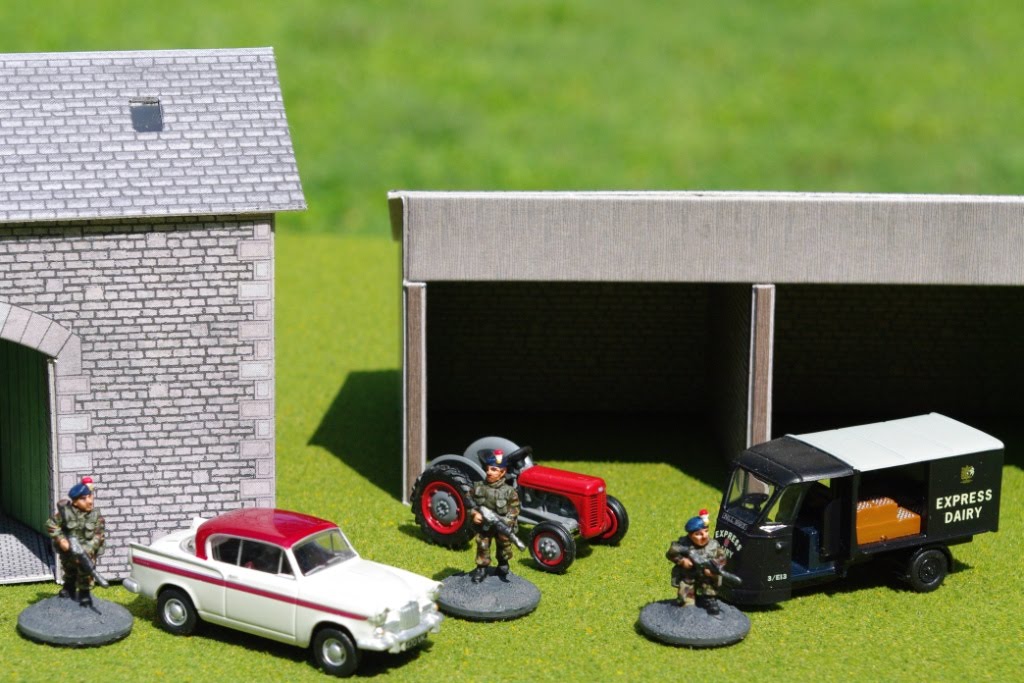
Below are pictures of the two structures that come in the Manor Farm Barn set, a barn & tractor shed. Also in the picture are a BW Model Hummer Pig, some 20mm Hotspur / Stonewall miniatures, and 1/76 scale diecast vehicles from the UK. As you can see, everything fits to scale. Also a nice touch to the Manor Farm sets is that all of them are based off real buildings that the owner of Metcalfe Models, Nick Metcalfe, grew up around as a child.


Below to the left is the Manor Farm House set, which has the Manor house and a worker's cottage. To the right is the Manor Farm Buildings set, which has a silo pit, a modern barn, a small hen house, and a large hen house.


Next is a front and side view of the Coaching Inn kit.


Finally is the Village School set, which includes the school and outbuilding for toilets and storage. This kit is also based on Nick Metcalfe's childhood school.


Finally, a picture that has some foreshadowing meaning...hmmm....(side note, after taking this picture, I accidentally broke the front landing gear and lost the wheels...sigh...I am going to have to make some crappy replacements now.)


Until later...

Wednesday, July 7, 2010

I have been very bad

I just realized that I have not posted anything in two months! Sorry!

I really have not been working on anything, but last night I assembled two Metcalfe OO scale (1/76 or close to 20mm) cardboard buildings. Both are from the Manor Farm House set. They are a real treat to assemble! Tonight, I will be working on the farm building and maybe the tractor shed from the other Metcalfe's set, Manor Farm Barn. I am hoping to get these done before the weekend. As soon as I complete them, and have time, I will work on the third Metcalfe's Manor Farm's sets, Manor Farms Buildings. Hopefully, I will take some pictures over the weekend to show what the completed kits look like. They are very nice and I honestly can't say enough good things about them.

I also got the first of my OO scale British civilian cars and trucks. I want proper English cars for my game. I got about a dozen now, so I get some pictures of them, the buildings, the BW Models, and the Hotspur's miniatures in the pictures for size comparisons. I think that they all go very nicely together.

Maybe, I might actually pull out a paint brush this weekend too! It only has been four months!

Finally, I am hoping to run a very small Force on Force game in the next few weeks. The main problem is I can't find out if I have to work on a Sat. yet or not. They keep changing their minds...grr...Be on the look out for the AAR on that, hopefully soon.

Oh, one last thing...I added the device to show who is following my blog (Thank you!) and I added some more links to various other blogs (keep up the good work!) and gaming forums. If you have not looked at them earlier, give them a look over.

Ta!

Monday, May 3, 2010

CWC Vietnam AAR – “It was a very good day for Charlie”

Well after a whole year, and almost an additional month, I finally got around to running another Vietnam game (and actually the first game in a year as well!) This is a quick After Action Report (AAR) of the game. I forgot to bring my camera, so the photographs below were taken by Curtis T. (Thanks, Curtis!) I will try to get everything correct, but I did not make any notes immediately after the game and I waited over a week to type up this AAR, so I may have made some errors. The Americans were played by Pat L. (Aero Rifle platoon leader), Curtis T. (Leg Infantry platoon leader), and Blake W. (Armored Cavalry platoon leader and Overall Commander). The People’s Army of North Vietnam (PAVN or NVA) was commanded by Steve H.  
 
Scenario 

Each stand of infantry represented a squad of infantry or one vehicle. The Americans players were told that this is 1972 and the bulk of the Americans have been pulled out of Vietnam with the exception of a few units that will be cycled back as equipment & materials are handed over to the ARVN (South Vietnamese army). Their command is one of those units. Their troops’ morale is poor as no one wants to be the last to die for Vietnam, as such none of their infantry will engage in close assault with enemy forces and they also have an additional -1 to command rolls for moving orders if engaged in small arms combat, but not for shooting (they much rather just keep shooting until the enemy is dead instead of moving). 

The terrain was heavy with jungle and woods as to make up for the lack of hills for the area around the DMZ. There were two small farms on the board that were separate from each other. A road ran the length of the board (north to south) with a small cross road connecting the two farms.

The board with the south edge being at the bottom of the picture

The Americans forces consisted of an aero rifle platoon (1x headquarters, 3x infantry, and 1x machine gun stands, plus 4x Huey slicks); a leg infantry platoon (1x headquarters, 3x infantry, and 1x machine gun stands); and an under strength armored cavalry platoon (1x headquarters, 3x M113 ACAV, and 1x M551 Sheridan); plus there was a Commanding Officer stand, 2x 105mm off-board artillery support, and a 1x off-board air support (more will be discussed about the air support later). The CO was to be assigned to the armored cavalry and while this was a Free Fire Zone, the players were not allowed to call in artillery or air support until they had a confirmed sighting of enemy troops.

 The PAVN forces consisted of 1x CO, 2x headquarters, 12x infantry, 1x mortar, 2x unarmed porters units, and 2x PT-76 tanks that would come in as reinforcements. The PAVN was allowed one Ambush and everything else was under hidden blinds.

 The American Armored Cavalry platoon and the Leg Infantry platoon off to one side of the board while players were decided what they wanted to run.

The Americans were instructed to move up and determine where the enemy was located, engage them and inflict heavy casualties; the PAVN’s objects was to hold the US long enough to get the unarmed porters off of the board (who could not start moving until the PAVN had engage the US in one round of combat.)

The US decided to have the leg infantry platoon ride on the tracks from the armored cavalry, while the aero rifles would fly in an land right next the farm on the west side of the board…it all went downhill for American players after that. What was to follow was just sad. 

Turn One 

The aero rifles under LT Pat lands between the farm and the rice paddies. As the Huey ‘slicks’ were touching down, deadly AK-47 fire was coming from a hidden bunker under the farmhouse. First Squad was ripped to shreds as they scrambled off their ‘Slick’ and into a perfectly laid out kill zone. The rest of the aero rifles platoon and the ‘Slick’s’ door gunners returned fire but with the surprise factor and seeing 1st Squad casualties, the fire was only able to suppress some of the PAVN forces.

The armored cavalry platoon under LT Blake slowing advance up the road as if it was a Sunday morning back in the States, without a care in the world (they only made one command roll – oddly enough, this was going to the standard for them pretty much through the rest of the game).

The leg infantry platoon under LT Curtis decided to dismount one squad to check out a possible ambush site (a hidden marker) along the road. As LT Curtis told the 3rd Squad to dismount, a single shot rang out from their ACAV which just missed hitting him in the head…the other track was claiming it was an accidental discharge, but LT Curtis was not so sure about that. (Curtis rolled a commanded blunder and got a ‘Cease Fire’ blunder resulting in one shot at his HQ…nothing quite like setting the proper mood for the rest of the game!)

The PAVN under Comrade Steve starts moving their porters towards the north and the hidden marker in the rice paddies on the opposite side of the aero rifle platoon turns out to be a single rifle squad.

 Losses – US: 1, PAVN: 0


The aero rifle platoon in one of its better moments

Turn Two
 
LT Pat tries splitting his platoon’s fire between the bunker under the farmhouse and the PAVN troops in the rice paddies. He is unsuccessful. He starts to call back in the ‘Slicks’ to help lay down some fire, but is unable to contact them (only one successful command roll).

 LT Curtis successfully yells at the other squad to get off the ACAV and check out the wood line. They advance up to the woods and stop, refusing to go any farther (again, only one successful command roll!) 

LT Blake however is watching the howling monkeys in the trees and is thinking how he can ship one back to the US (failed command rolls). 

Meanwhile, the PAVN forces at the farm are determine to show that they are heroes that Uncle Ho was referring to as they lay accurate fire into the 2nd Squad until they don’t see them moving anymore. 

Losses – US: 2, PAVN: 0

The soon to be infamous 'missing' squad deciding if they should go into the woods

Turn Three
 
LT Pat is realizing that things are going from bad to worse for him as he is too close to call in artillery or air support, so he calls back the ‘Slicks’ to help lay down fire on the bunker and in the rice paddies. While the additional firepower from the door gunners, he now sees that he is successfully hitting the enemy, but only suppressing them at best.

LT Curtis, after throwing a can of Ham & Beans from his C-rations at his 3rd Squad, was able to get them to adventure into the woods to find some old copies of Playboy and a long abandoned campfire. Deciding to stop and look at the centerfolds, they didn’t hear LT Curtis yelling for them to get back to the tracks. 

LT Blake is now thinking about if he left his footlocker unlocked back at the base camp (can you guess how many successful command rolls were going on here?)

Driving south, two PT-76s appear on the field in replies to request of assistance from Comrade Steve. Back over the PAVN bunker, as one PAVN squad cowards toward one side the bunker, the other squad shows that they are the foundation for victory over the capitalist invaders as they then switch their sites to the aero rifle’s 3rd squad. In a few violent seconds, another US squad was removed from their beloved lands.

Losses – US: 3; PAVN: 0 
 
Turn Four 

LT Pat looks back at his faithful RTO and can see the fear in his eyes, “There is a whole group of Charlie’s shooting like Alvin York! We got to get out of here!” LT Pat calls in the ‘Slicks’ to make one more pass to light up the bunker. With just a machine gun squad and some LAWs, and the door gunners from the circling ‘Slicks’, LT Pat directs the fire into the bunker. Finally able to bracket the slits, he is successful in suppressing one of the two PAVN squads.

LT Curtis starts jumping up and down on top of the ACAV at his 3rd squad to come back to the tracks, it appears that they found something more than some old copies of Playboy in the abandon camp site.

LT Blake all of a sudden remembers that he is suppose to be linking up with the aero rifle platoon, and orders his command forward…leaving behind LT Curtis’s 3rd squad in the dust.

The PAVN PT-76’s drove as fast as they could until they were able to get themselves in a good position to engage the Americans that would come to rescue the badly bloodied aero rifle platoon. Back at the bunker, rounds were being traded, but with no losses on either side.

Losses – US: 3; PAVN: 0

Random scenes from Turn Four. Notice in the first one the abandoned US infantry squad!


Turn Five
 
“I don’t care if it is hot or not, get that chopper down here now!” LT Pat screamed into the handset of the PR/C 77 radio. As the ‘Slick’ came in to pick up the survivors of the aero rifle platoon, rounds went flying in and rattled inside it. The door gunner witness the rounds ripping into the engine and seeing the thick, oily smoke bellowing out just before the Huey went into a spin and collided with the ground. Nguyen, back in the bunker smiled as pulled out his now empty clip from his AK-47.  With fury, the remaining 'Slicks' door gunners opened up on the PAVN squad in the rice paddies and riddled them with 7.62mm rounds.

LT Curtis started yelling, “Dismounted, get to the wood line and take up fighting positions” as the ACAV’s came to a halt. All of his platoon dismounts and runs in the woods as he is left there wondering if they did it because he order them to or if they did it because they did not want to be around the ACAVs with PAVN tanks in the area.

LT Blake directs the M551 to drive around the wood line and report what he sees. As the M551 reaches the crossroads, two shots are heard from a far and the M551 is seen to shudder a little bit before suddenly it is replaced by an orange ball of fire. This seems to jolt LT Blake back to fact that he is in Vietnam!  “Hard right turn, head back to the base camp!” LT Blake yells in to mic as the ACAV drivers obey. 
LT Curtis stands there with his jaw on the ground as the ACAV abandon him and his platoon as they drive hell bent for leather back for the base camp (Yes, Blake decided that running away was the best option and he rolled a critical command success! Amazing, the only time a critical success is rolled and it applies to a retreat!)

The crews of the two PT-76s let off a cheer as they see their shots caused an American tank to catch on fire.  In the bunker, Comrade Steve looked over at the dead PAVN soldiers in the rice paddies, “Their love for Uncle Ho was weak, that is why they died” as he said to follow comrades, “But they were still our brothers, these Americans will pay dearly.” With that, Comrade Steve trained his iron sights on an American machine-gun team and squeezed the trigger with deadly accuracy.

Losses: US: 6, PAVN: 1 (The US has now just reached it Breakpoint to start rolling for the force's overall morale.)

The view from the PAVN side at the stalled American advance...but wait, what is that in the distance


Turn Six  

“Hey, I can see those tanks from here”, the RTO points out to LT Pat after seeing the fireball in the sky from a burning M551. “Give me that handset, ‘This is November One-Niner Lima, I have an airstrike mission’” LT Pat spoke into the radio’s handset.

A South Vietnamese F-5 Freedom Fighter was vectored in on the mission and successfully drops napalm on the two PT-76s, knocking both out. LT Pat then convinces one of the braver ‘Slick’ pilots to come down and retrieve both him and the down crew from the previous Huey. 

As Comrade Steve is pulling out a new clip of ammunition, he drops it in the mud. Reaching down and grabbing it to clean off the mud, he fails to see the Americans jumping on another Huey until it is too late, it gets away from him. 

LT Curtis is still amazed that the cavalry just abandoned his platoon…it was going to be a long march back to the base camp. 

Losses: US: 6, PAVN: 3
  
The South Vietnamese Air Force to the rescue!
 
-->
The game was called at this point as two of the three US commands were no longer in the game and the PAVN was in very good defensive positions. As a joke, we gave Blake a 50/50 shot that he was going to be fragged by Curtis’ men at the base camp before he got cycled back to the US, he lived. Pat did not have to worry about be fragged as all of his command was dead. The other thing that we had joked about is that the Vietnamese (both North & South) had a far better kill ratio then the Americans…this was truly a 1972 American Army that was on the board. 

Hopefully this was a still a fun enough game for the American players, even with all of the horrible dice rolls.